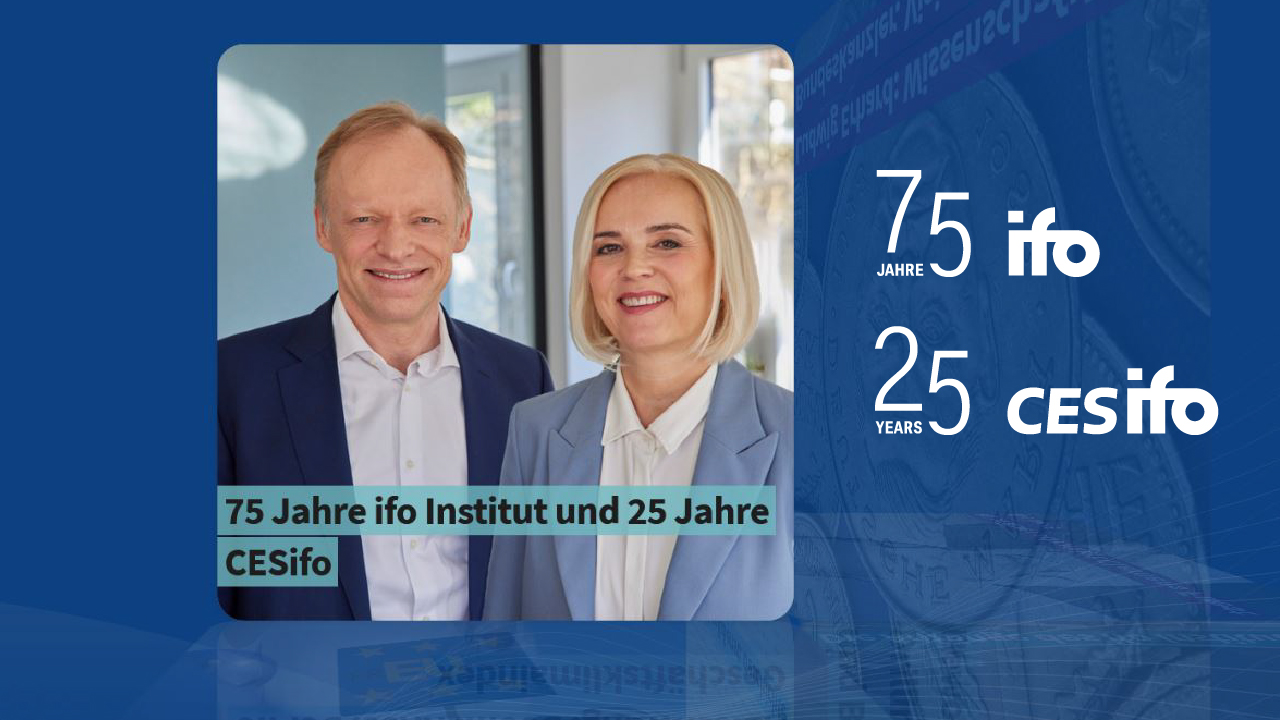
The CESifo Group, consisting of the Center for Economic Studies (CES), the Ifo Institute and the CESifo GmbH (Munich Society for the Promotion of Economic Research) is a research group unique in Europe in the area of economic research. read on CESifo Group Munich
- News
- Survey results
- Upcoming events
- New Publications
-
Contrary to standard microeconomic principles, it is by now well understood that income is not fungible. For example, the label of a government transfer can induce individuals to make expenditure decisions that are skewed towards the label. In Ifo Working Paper No. 163 Timo Hener shows that child benefits are disproportionately used for savings assignable to children. His results suggest a significant positive labeling effect on longterm savings. However the labeling effect is weak when looking at consumption goods.
Details
-
Using firm-level survey data for the West German manufacturing sector, Rüdiger Bachmann and Peter Zorn in CESifo Working Paper No. 4218 revisit the technology-driven business cycle hypothesis for the case of aggregate investment. They construct a survey-based measure of technology shocks to gauge their contribution to short run investment fluctuations. They find evidence for technology shocks explaining a significant fraction of the fluctuations of aggregate investment growth. However, the larger part must be attributed to finance and demand shocks.
Details
-
Heightened inflation uncertainty can have subsequent economic costs. Uncertainty distorts the signaling effect of price systems and makes stability-oriented monetary policy more difficult to implement. In CESifo Working Paper 4194 Steffen Henzel and Elisabeth Wieland look at the question of whether there is an international intertwining of inflation uncertainty in the G7 states. They show that inflation uncertainty is internationally synchronized and that the linkage grows even higher over time. Moreover, an international component can be identified that exercises a decisive influence over national inflation uncertainty in G7 states.
Details
-
How does a country’s output change if the number of employed or net investments increases? And what impact does this have on other countries? In Ifo Working Paper 161 Sebastian Benz and Markus Zimmer as well as Ifo research professor Mario Larch develop a theoretical model that allows them to characterise the production structure of 11 countries in the European Union by taking into account trade in intermediate goods and internationally mobile capital. One of the conclusions reached by the authors is that all countries increase their output if the number of employed at every level of qualification rises in the country in question. At the same time, however, capital mobility and trade in intermediate input tends to lower the output in other countries.
Details
-
Is the lawsuit filed by Hessen and Bavaria against the Länder fiscal scheme equalisation (Länderfinanzausgleich) an overdue step in protest at unfair distribution? This is the central question examined by politicians and academics in the latest ifo Schnelldienst 9/2013. According to Volker Bouffier, Minister President of the State of Hessen, the lawsuits is not against the Länder fiscal equalisation scheme per se but against the deficits of the existing scheme. Norbert Walter-Borjans, Finance Minister of North Rhine Westphalia, on the other hand, describes the behaviour of the plaintiffs as lacking in solidarity and stresses that the fiscal equalisation scheme has stood the test of time to date. The academics Rolf Peffekoven, Joachim Wieland, Thomas Lenk and Nathalie Behnke also give their views on the issue.
Details
-
Results of the Ifo World Economic Survey (WES) of 2nd quarter 2013 (15 May 2013)
May 15, 2013:
The Ifo World Economic Climate Indicator continued to rise, even if only slightly. Both assessments of the current economic situation and the six-month economic outlook improved slightly compared to the previous quarter. There are a growing number of signs that the world economy is stabilising.
Details
-
Advance results of the Ifo World Economic Survey (WES) of 2nd quarter 2013 (08 May 2013)
May 8, 2013:
The Ifo Economic Climate Indicator for the euro area remains at a low level. Assessments of the current economic situation are slightly less favourable than in the last survey. Expectations for the six-month economic outlook improved only slightly. An economic recovery has not yet started.
Details
-
Regional evaluation for Saxony of the Ifo Business Survey in April 2013
May 4, 2013:
The Ifo Business Climate Index for German trade and industry declined once again in April. The business climate indices for Eastern Germany and Saxony also fell sharply. Saxon survey participants were notably far less positive about their current business situation than in March. They also expressed greater pessimism than last month about their six-month business outlook.
Details
-
Ifo Export Climate for March 2013
May 1, 2013:
The Ifo Export Climate improved in March 2013, reaching -0.55 points. The increase in the export climate is due to an improvement in pricing competitiveness. This, in turn, can be attributed to the weakening of the euro against the US dollar in March. The euro depreciated by 3% against the US dollar in March versus the previous month.
Details
-
From the Ifo Business Survey for April 2013
Apr 30, 2013:
Credit constraints for German trade and industry edged downwards by 0.1 percentage points compared to March. Around a fifth of the companies surveyed reported a restrictive credit policy on the part of banks. Despite recent developments in the euro crisis, there have been no significant changes in the favourable financial environment of German companies.
Details
-
Ifo Employment Barometer - Results of the Ifo Business Survey for April 2013
Apr 30, 2013:
The Ifo Employment Barometer for German trade and industry, including the service sector, fell in April. German companies are very cautious about recruiting additional staff.
Details
-
Results of the Ifo Business Survey for April 2013
Apr 29, 2013:
The Ifo Business Climate for Eastern German trade and industry clouded over considerably in April. Eastern German survey participants assessed their current business situation considerably less optimistically than last month. They also expressed greater caution about their six-month business outlook. After a strong start to the year, the Eastern German economy is losing momentum slightly.
Details
-
Results of the April 2013 Ifo Business Survey
Apr 24, 2013:
The Ifo Business Climate Indicator for the German service sector fell considerably in April. Assessments of the current business situation were significantly less positive than last month. The service providers surveyed were also slightly less optimistic about their business outlook. They nevertheless plan to recruit additional staff.
Details
-
Results of the April 2013 Ifo Business Survey
Apr 24, 2013:
The Ifo Business Climate Index for German industry and trade fell in April. Although the majority of companies assessed their current business situation as good, they were far more cautious than last month. Their expectations regarding future business developments were also lower. The German economy is taking a breather.
Details
-
Regional evaluation for Saxony of the Ifo Business Survey in March 2013
Apr 10, 2013:
After last month’s sharp rise, the Ifo Business Climate Index for German trade and industry edged downwards in March. The climate indicators for Eastern Germany and Saxony also deteriorated this month. Saxon survey participants remain thoroughly satisfied with their current business situation, but are far more pessimistic about their future business developments.
Details
How safe and sustainable is nuclear energy? These are the questions that Professor Andreas Pautz, Institute Director at the Ecole Polytechnique Federale of Lausanne, will focus on in the framework of the Munich Seminars. On Monday 27 May 2013, he is due to give a seminar entitled: “The Outlook for Nuclear Energy and Safety Research in the Context of the Energy Debate”. The seminar will be given in German in the Ludwig-Erhard-Saal of the Ifo Institute and will be livestreamed via the internet on the CESifo web site. It is scheduled to begin at 6.00 p.m. read on Professor Andreas Pautz about the Outlook for Nuclear Energy and Safety Research
As the fifth year of the crisis rolls on, Europe is facing a double challenge: to improve its competitiveness, and to stabilise the euro zone. Comprehensive reforms and deeper integration should lead to a new, stronger Europe. Under the title “Relaunching Europe”, the Summit will focus on how Europe can boost out of its low-flying phase. read on 12th Munich Economic Summit, 16 - 17 May 2013: “Relaunching Europe”
For upcoming and past conferences and seminars consult
Just released
-
Sinn, Hans-Werner,
Verspielt nicht eure Zukunft, Redline, 2013, 112 , Information
| Details
Journals
-
"ifo Schnelldienst 09/2013", ifo Institut, München, 2013, 03-55
| Details
-
Cour-Thimann, Philippine,
"CESifo Forum Special Issue April 2013: Target Balances and the Crisis in the Euro Area", Ifo Institute, Munich, 2013, 05-50
| Details | Download
-
"CESifo Forum 1/2013 (Spring)", Ifo Institute, München, 2013, 03-71
| Details | Download
-
"ifo Konjunkturperspektiven 04/2013", ifo Institut, München, 2013
| Details
-
"ifo Dresden berichtet 2/2013", ifo Institut, Dresden, 2013
| Details | Download
-
"ifo Schnelldienst 08/2013", ifo Institut, München, 2013, 03-77
| Details | Download
Books
-
Rainer, Helmut, Stefan Bauernschuster, Natalia Danzer, Timo Hener, Christian Holzner and Janina Reinkowski,
Kindergeld, ifo Forschungsberichte 60, ifo Institut, 2013
| Details | Download
Working Paper
-
Bjørnskov, Christian and Niklas Potrafke,
"The Size and Scope of Government in the US States: Does Party Ideology Matter?", CESifo Working Paper No. 4246, May 2013
| Details | Download
-
Hener, Timo,
"Labeling Effects of Child Benefits on Family Savings", Ifo Working Paper No. 163, 2013
| Details | Download
-
Bjørnskov, Christian and Niklas Potrafke,
"The size and scope of government in the US states:
Does party ideology matter?", Ifo Working Paper No. 162, 2013
| Details | Download
-
Benz, Sebastian, Mario Larch and Markus Zimmer,
"The Structure of Europe:
International Input-Output Analysis with Trade in
Intermediate Inputs and Capital Flows", Ifo Working Paper No. 161, 2013
| Details | Download
-
Bachmann, Ruediger and Peter Zorn,
"What Drives Aggregate Investment?", CESifo Working Paper No. 4218, April 2013
| Details | Download